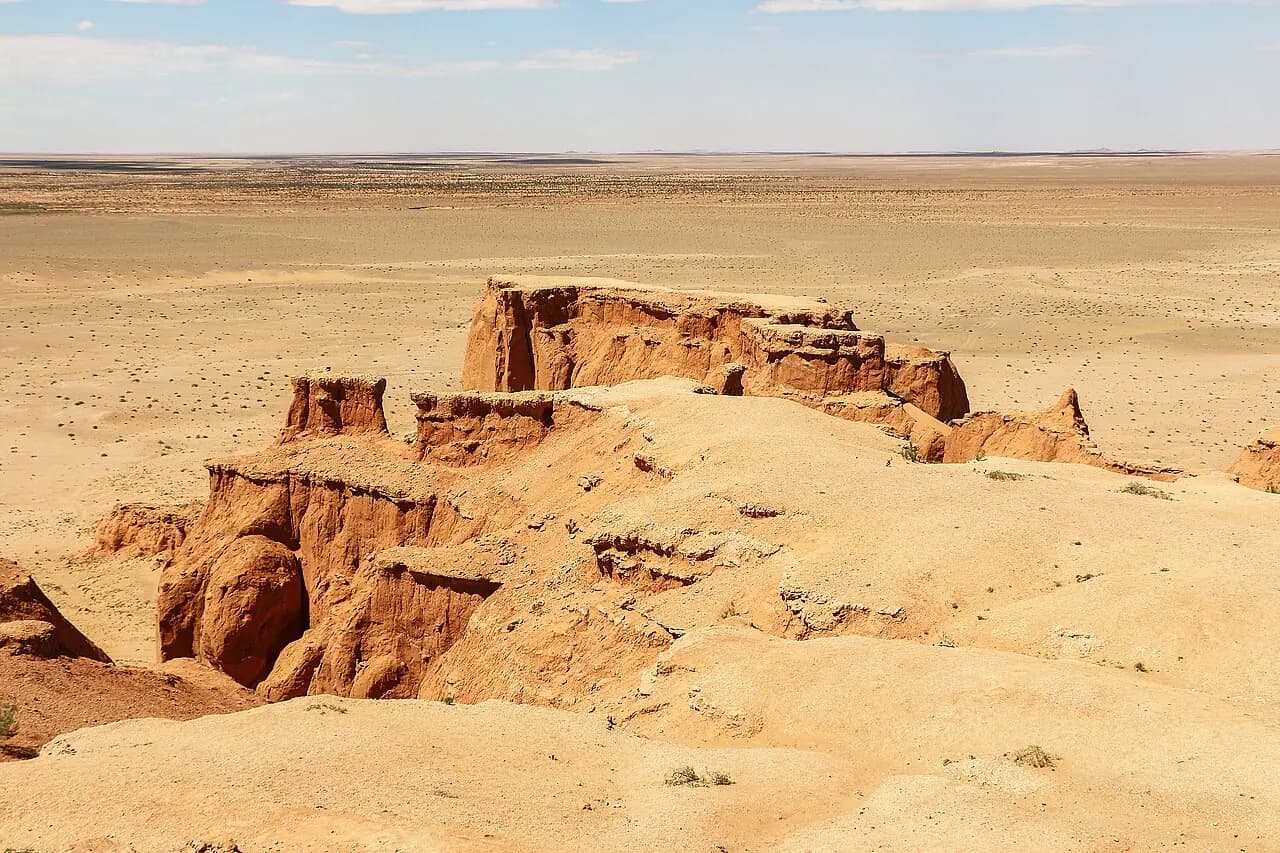
The red cliffs where dinosaur eggs were first discovered.
Bayanzag, the Flaming Cliffs, is a line of red and orange sandstone bluffs rising out of the flat Gobi plain in Ömnögovi. It is the place where the first dinosaur eggs recognised by science were found in the 1920s, and the cliffs still turn a deep red in the last hour of sunlight. The Mongolian name means 'rich in saxaul', after the desert trees that grow on the plain nearby.
A landscape of eroded sandstone
The cliffs expose the soft, sandy rocks of the Djadokhta Formation, laid down when this area was a dry landscape of sand dunes. Wind and rare cloudbursts have carved the edge into gullies, buttresses and free-standing pillars, and the rock crumbles easily underfoot. Fossils of Protoceratops, Velociraptor, Oviraptor and the armoured Pinacosaurus have all come from these beds. Fragments still weather out of the slopes, but removing fossils without a permit is illegal in Mongolia, so look and leave them in place.
The saxaul woodland
A short drive from the cliffs grows a stand of saxaul (Haloxylon ammodendron), a leafless-looking shrub or small tree that usually grows 2 to 8 m tall. Its leaves are reduced to tiny scales and its spongy bark holds water, which lets it survive on sand where little else grows. The trees help to hold the sand in place. Collecting the dead wood for fires damages this rare woodland, so bring your own fuel.
Planning your time
Most visitors spend an afternoon and evening here: two hours on the rim and in the gullies, then the sunset. The edge is undercut in places and can give way, so keep well back from overhangs and do not climb the pillars. Summer days are hot, often around 30 °C in July, so walk early or late, carry water and wear shoes with good grip.
Photo: Bernard Gagnon · CC0 · Wikimedia Commons
History
The history of Bayanzag (Flaming Cliffs)
The Flaming Cliffs
In 1922 the American Museum of Natural History's Central Asiatic Expeditions, led by Roy Chapman Andrews, reached these red sandstone cliffs. Andrews named them the Flaming Cliffs for the way they glow at sunset. The Mongolian name, Bayanzag, means 'rich in saxaul', after the desert shrubs that grow here.
The first dinosaur eggs
In 1923 the expedition found the first nests of dinosaur eggs recognised by science. They also found the first skeletons of Protoceratops, Velociraptor and Oviraptor. The rocks belong to the Djadokhta Formation, laid down in a dry, dune-filled landscape about 75 to 71 million years ago.
Fighting Dinosaurs
In 1971 a Polish-Mongolian expedition found the famous Fighting Dinosaurs at nearby Tugrugiin Shiree: a Velociraptor and a Protoceratops locked in combat, probably buried by a collapsing dune. It is one of Mongolia's national treasures and is on display in Ulaanbaatar. Collecting fossils at Bayanzag is forbidden.
Things to do at Bayanzag (Flaming Cliffs)
4 activities · best season: Summer, Autumn, Spring
Hiking · 1–2 h
Walk the rim of the Flaming Cliffs
Follow the edge of the red cliffs and drop into the gullies. Late afternoon, when the sandstone glows, is the best time.
History · 1 h
Stand where dinosaur eggs were first found
Roy Chapman Andrews' expedition found the first known dinosaur eggs here in 1923. Fossils remain, but collecting them is forbidden.
Photography · 1 h
Photograph the cliffs at sunset
The colours change fast in the last hour of light; arrive early to pick a spot on the rim.
Nature · 1 h
Walk through the saxaul forest
Bayanzag means 'rich in saxaul'. A short drive from the cliffs, these hardy desert trees form one of the Gobi's rare woodlands.
When to go & how to get there
Weather by month
Getting there
Bayanzag lies about 100 km north-west of Dalanzadgad, on the usual Gobi loop between Dalanzadgad and Khongoryn Els. Fly or take the bus from Ulaanbaatar to Dalanzadgad, then continue by hired 4x4.
Where to stay
Ger camps lie a few kilometres from the cliffs; most Gobi tours spend a night here between Yolyn Am and the dunes. Bulgan soum, 20 km away, has basic shops and guesthouses.
Gallery
5 photos · tap to enlarge · sources credited on each photo
Where is Bayanzag (Flaming Cliffs)?
from Ulaanbaatar from Dalanzadgad · a dotted end marks a stretch with no road
Ömnögovi province · nearest town: Bulgan soum
Guides that mention Bayanzag (Flaming Cliffs)
- Mongolian GeographyMongolian geography explained: the Altai, Khangai and Khentii ranges, Lake Khövsgöl, rivers, steppe, the Gobi Desert, the extreme climate and travel tips.
- Tourism in MongoliaTourism in Mongolia explained: top regions from the Gobi to Khövsgöl and the Altai, the travel season, transport, ger camps and how trips are usually organised.
- Mongolia Travel MapMongolia travel map explained: the Gobi, Central Khangai, Khövsgöl in the north, the western Altai and the eastern steppe, with classic routes from Ulaanbaatar.
- Gobi Desert Tour MapGobi Desert tour map: the classic 6–8 day loop from Ulaanbaatar via Tsagaan Suvarga, Yolyn Am, Khongoryn Els, Bayanzag and Kharkhorin, with rough distances.
- 15 Facts About the Gobi Desert15 facts about the Gobi Desert: its size, cold climate, dunes, dinosaur fossils, Gobi bears, wild camels and mineral wealth, plus tips for visiting.
- Top 10 Places to Visit in MongoliaTop 10 places to visit in Mongolia, from Ulaanbaatar and the Gobi dunes to Kharkhorin, Lake Khövsgöl and the Altai, with tips on planning your route.
Gobi
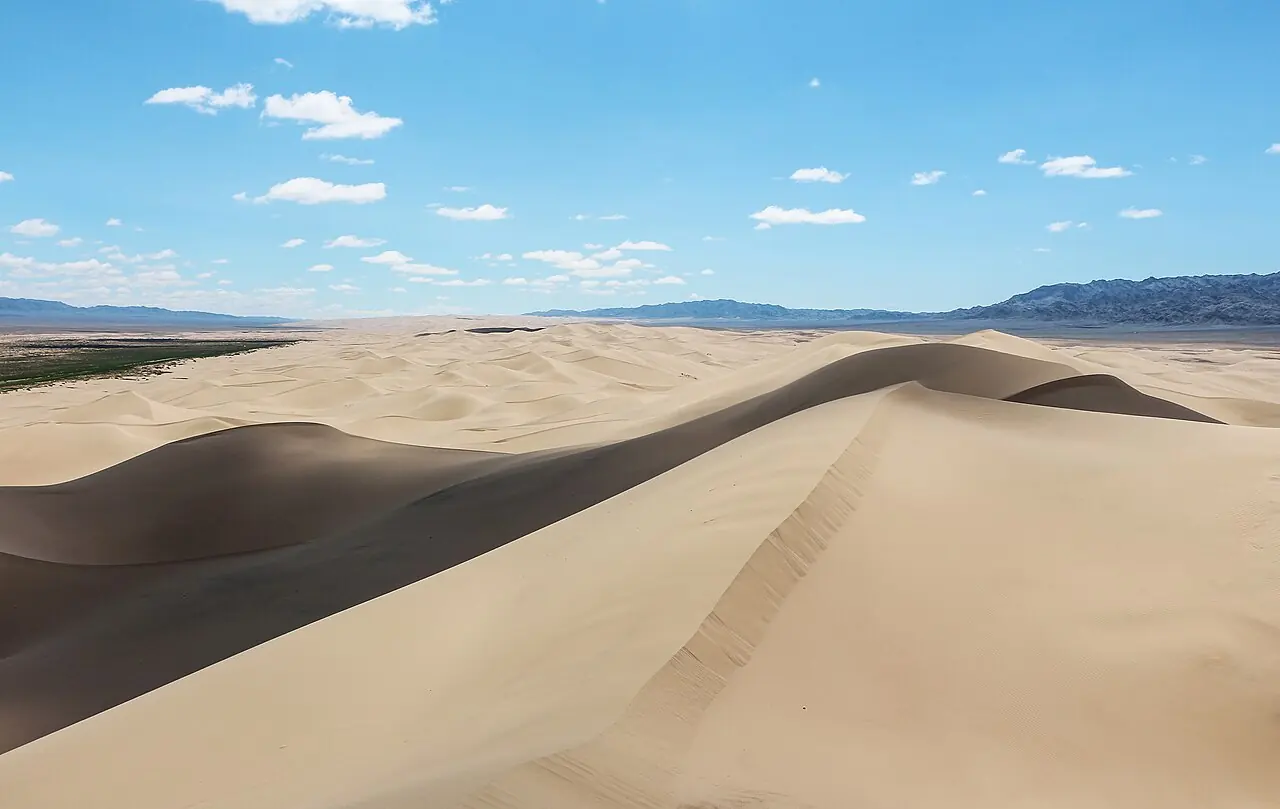
Khongoryn Els
The 'singing sands': one of Mongolia's largest dune fields, with ridges said to reach 300 m.
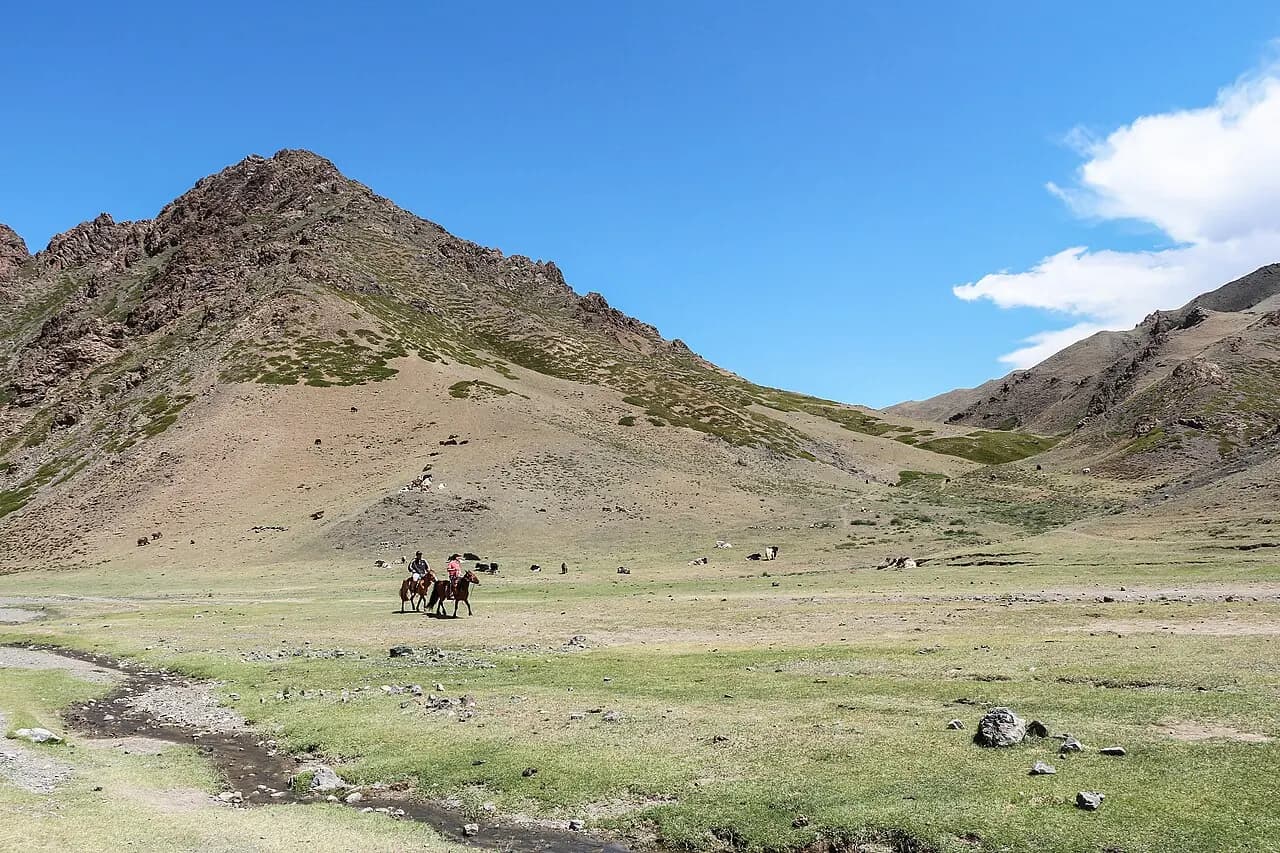
Yolyn Am
An ice-filled gorge in the heart of the Gobi; the ice survives into midsummer.
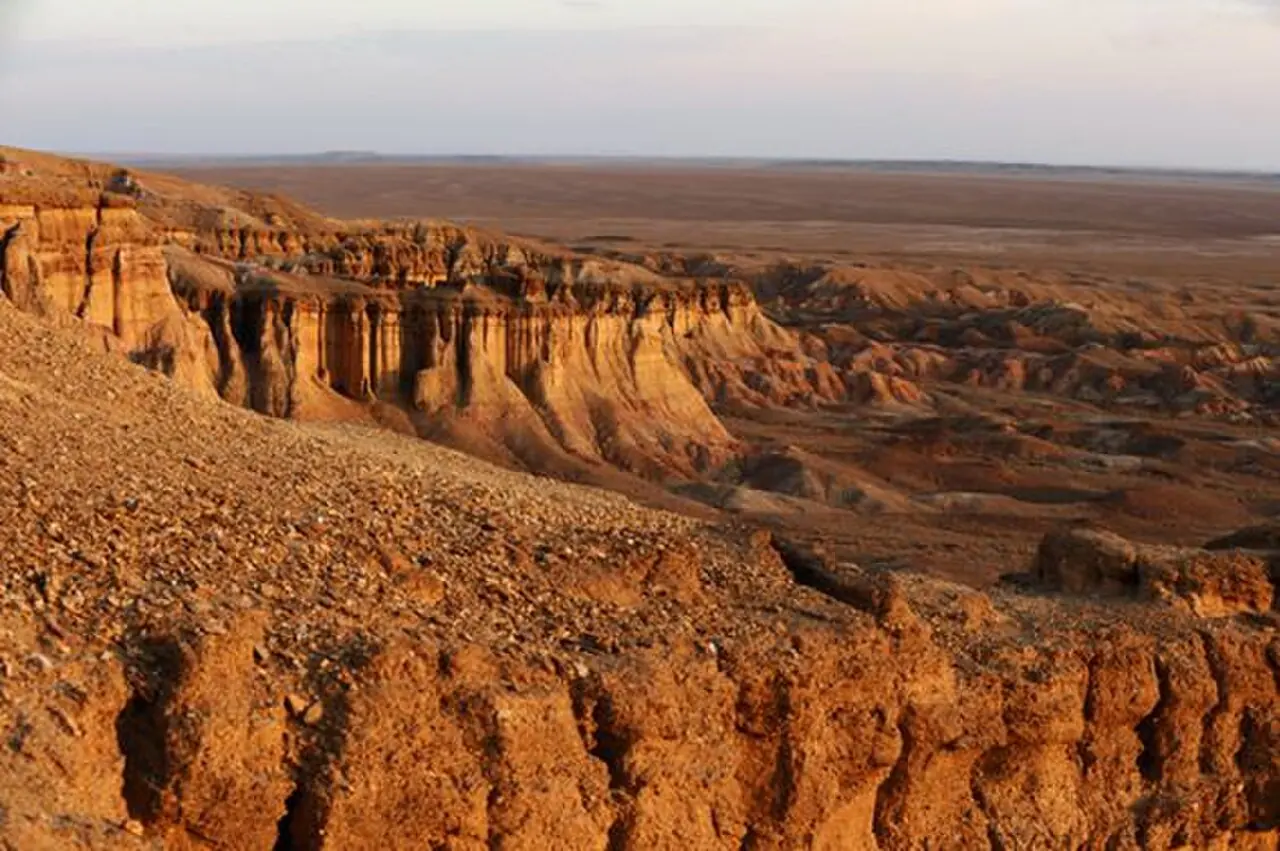
Tsagaan Suvarga
A 60 m wall of multicoloured clay, once a sea floor.