The Mongolian Language: Family, Dialects and How It Works
Mongolian language guide: the Mongolic family, Khalkha and other dialects, about 5 million speakers, vowel harmony, Cyrillic ө and ү, and pronunciation.
4 min read · Updated
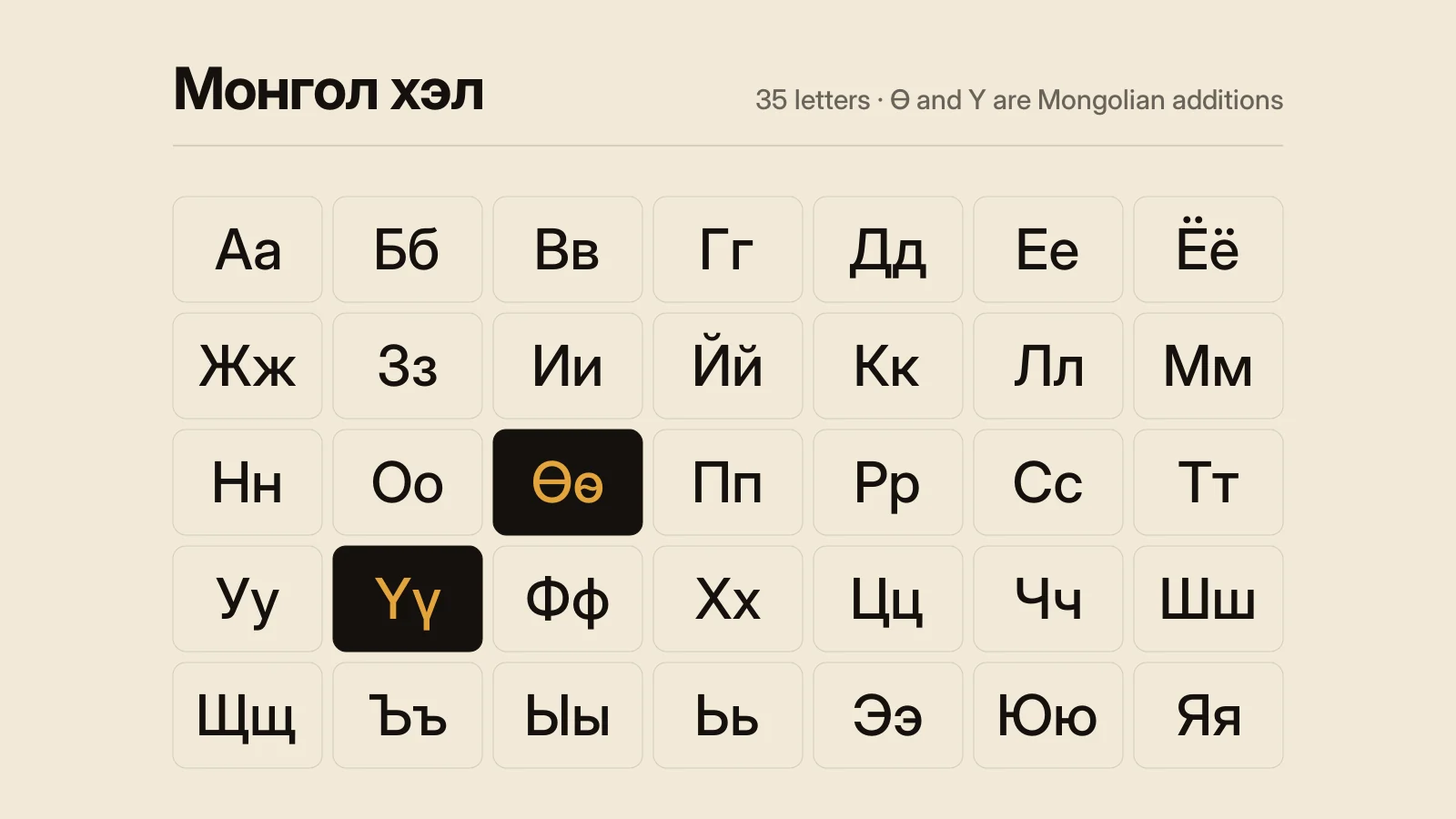
Photo: MongoliaHandbook · CC BY 4.0
Mongolian (Mongol khel, Монгол хэл) is the national language of Mongolia and an official language of China's Inner Mongolia Autonomous Region. It is the largest member of the small Mongolic language family, and Ethnologue's 2025 edition puts its speakers at about 5 million, based on figures from 2020 to 2022. In Mongolia it is written in Cyrillic.
The Mongolic language family
Mongolian descends from Middle Mongol, the language of the Mongol Empire in the 13th and 14th centuries. Older textbooks placed Mongolic in an "Altaic" family with Turkic and Tungusic, but most linguists now explain the shared features by long contact rather than common descent. Mongolian is not related to Chinese or Russian, although it has borrowed from both.
Its closest relatives are:
- Buryat, spoken around Lake Baikal in Russia and in parts of northern Mongolia and Inner Mongolia, with about 440,000 speakers.
- Oirat, spoken in western Mongolia (Khovd, Uvs and Bayan-Ölgii provinces) and in Xinjiang.
- Kalmyk, the form of Oirat used in Kalmykia on the Caspian steppe of European Russia, by descendants of Oirats who reached the lower Volga around 1630. Russia's 2021 census counted about 110,000 speakers.
- Smaller languages in China, such as Dagur, Monguor and Santa (Dongxiang).
Linguists still debate whether Buryat and Oirat are separate languages or dialects of Mongolian.
Khalkha and other Mongolian dialects
Standard Mongolian in Mongolia is based on Khalkha (Khalkh, Халх), the dialect of the Khalkha Mongols, who made up about 84 percent of the population in the 2020 census. Almost all of Mongolia's roughly 3.5 million people (2024) speak Mongolian; the main exception is the Kazakh minority, concentrated in Bayan-Ölgii province.
In Inner Mongolia the language is more varied: Chakhar is the basis of the standard there, and the Khorchin dialects of the east have more than two million speakers. One audible difference: Khalkha has ts where Inner Mongolian speech often keeps ch, so "blood" is tsus (цус) in Ulaanbaatar but closer to chus in Inner Mongolia. Inner Mongolia writes Mongolian in the traditional vertical script. Since 2020, Chinese education policy has moved several subjects in Inner Mongolia's Mongolian-medium schools to Mandarin, which prompted protests.
How Mongolian grammar works
Mongolian is agglutinative: meaning is built by adding suffixes to a word stem, often several in a row. The basic word order is subject, object, verb, so "I am learning Mongolian" is Bi mongol khel surch baina (Би монгол хэл сурч байна), literally "I Mongolian language learning am". It uses postpositions where English uses prepositions, has about eight grammatical cases and no grammatical gender.
The feature learners notice first is vowel harmony. The seven vowels fall into two sets, a, o, u and e, ö, ü, with i neutral, and a native word normally keeps to one set. Suffixes change to match: "from the city" is khotoos (хотоос), but "from the ger" is gerees (гэрээс).
Cyrillic letters ө and ү
Cyrillic was introduced in 1941 and became the official script in 1946. The Mongolian alphabet has 35 letters: the Russian alphabet plus ө (ö) and ү (ü). They are separate vowels: у (u) and ү (ü), or о (o) and ө (ö), distinguish words. Long vowels are written double, as in Улаанбаатар (Ulaanbaatar), and vowel length can change meaning.
Loanwords and everyday vocabulary
Core words are native: tenger (тэнгэр, sky), us (ус, water), mori (морь, horse), ger (гэр, home). Buddhism brought Sanskrit and Tibetan words, such as shashin (шашин, religion). Chinese supplied tsai (цай, tea) and buuz (бууз, dumplings), and Russian gave much 20th-century vocabulary, such as mashin (car). English now adds words like onlain. Mongolian also coins its own terms: a train is galt tereg (галт тэрэг), literally "fire cart".
Pronunciation tips and learning Mongolian
- Kh (х) is a throaty sound, like ch in Scottish loch.
- Ts (ц) sounds as in "cats", and z (з) sounds like dz.
- L (л) is breathier than English l, close to Welsh ll.
- U (у) is near the vowel in "put", while ü (ү) is nearer "food".
- Short vowels after the first syllable are often reduced, so words sound shorter than they look.
The US Foreign Service Institute lists Mongolian among its "hard" languages for English speakers, estimating about 44 weeks (1,100 class hours) of full-time study. The alphabet, though, takes only a few days to learn and makes signs and menus readable. For greetings and survival phrases, see our guide to essential Mongolian phrases.
Frequently asked questions
How many people speak Mongolian?
About 5 million, according to Ethnologue's 2025 edition (figures from 2020 to 2022). Most live in Mongolia, where almost all of the roughly 3.3 million people speak it, and in China's Inner Mongolia.
Is Mongolian related to Chinese or Turkish?
It is not related to Chinese. Mongolian shares features such as vowel harmony, suffixes and verb-final word order with Turkic languages, but most linguists today attribute this to centuries of contact rather than a common ancestor.
What alphabet is Mongolian written in?
Mongolia uses a 35-letter Cyrillic alphabet, the Russian letters plus ө and ү, and also teaches the traditional vertical Mongolian script in schools. In Inner Mongolia, Mongolian is written in the traditional script.