The Soyombo and Mongolia's National Symbols
The Soyombo symbol explained element by element, plus Mongolia's flag, state emblem, anthem and Nine White Banners, and where visitors can see them.
4 min read · Updated
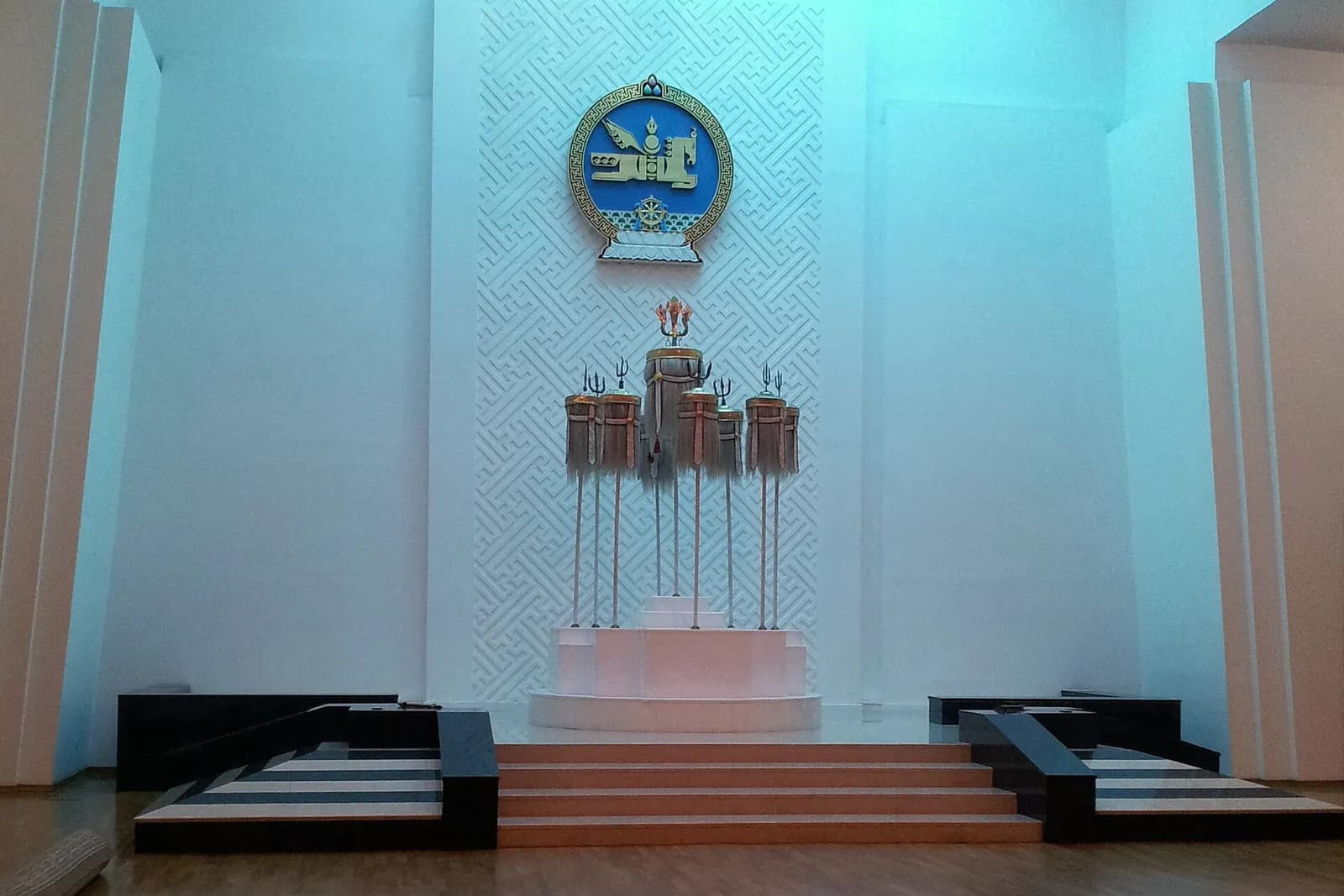
Photo: Chinneeb · CC BY 4.0 · Wikimedia Commons
Mongolia's national symbols are the Soyombo, the red, blue and red national flag, the round state emblem, the state seal, the national anthem and the traditional Nine White Banners. The Soyombo, a column of fire, sun, moon and geometric shapes created by Zanabazar in 1686, appears on both the flag and the emblem, whose present forms date from the 1992 Constitution.
What the Soyombo symbol means
The Soyombo began as a special sign marking the start of texts in the Soyombo script, which Zanabazar designed in 1686. The name comes from the Sanskrit svayambhu, "self-created". It has appeared on the flag since independence in 1911, apart from 1940 to 1945.
Interpretations differ between sources. The common reading, from top to bottom, is:
- Fire: growth, prosperity and continuity; its three tongues are often said to stand for past, present and future.
- Sun and crescent moon: the eternal existence of the Mongolian nation under the sky.
- Two downward-pointing triangles: arrow or spear points, signalling the defeat of enemies inside and outside the country.
- Two horizontal rectangles: honesty and justice among all people, whatever their rank.
- Two interlocking fish (a yin-yang shape): the unity of opposites; because fish never close their eyes, they also stand for vigilance.
- Two vertical bars: fortress walls, representing unity and strength, in the spirit of the proverb that two friends together are stronger than stone walls.
The flag of Mongolia: colours and history
The flag has three vertical bands of red, blue and red, with a golden Soyombo on the red band nearest the pole. The blue middle band, one third of the width, represents the eternal blue sky; the red bands are usually explained as progress and prosperity. Its proportions are 1:2.
The current flag took effect on 12 February 1992, together with the new Constitution, which removed the socialist-era star that had stood above the Soyombo since 1945. The exact shades were standardised in 2011. State Flag Day, set by a 2008 law, falls on 10 July, the day before the Naadam festival opens, with a flag-raising ceremony on Sükhbaatar Square.
The state emblem, the wind horse and the anthem
The state emblem, also introduced with the 1992 Constitution, is a circle on a white lotus base, framed by an endless tumen nasan pattern. On its blue field, for the eternal sky, a golden Soyombo is combined with a flying horse. Above it sits the chandmani (чандмань), a wish-granting jewel; below, a Buddhist wheel tied with a ceremonial khadag scarf rests on green mountains representing Mother Earth.
The horse is the khii mori (хийморь), literally "wind horse", a word also used for a person's spirit and vitality. With the Soyombo it stands for independence and sovereignty. The square state seal carries the emblem and is kept by the President.
The national anthem, Mongol Ulsyn töriin duulal, has music by Bilegiin Damdinsüren and Luvsanjambyn Mördorj and words by Tsendiin Damdinsüren. Adopted in 1950, it has been revised several times, most recently by parliament in 2006.
The white and black banners (tug)
A tug (туг) is a standard made from horse-tail hair hung below a round frame on a pole. The Nine White Banners (Yesön khölt tsagaan tug, Есөн хөлт цагаан туг) consist of a large central banner surrounded by eight smaller ones, each crowned with the Soyombo's three-tongued flame. They were the peacetime standard of the khans, and tradition links them to Chinggis Khaan's state of 1206.
The Constitution names the traditional Great White Banner of the unified Mongol state as a state ceremonial symbol. The banners regained prominence after the democratic changes of the early 1990s and are kept in the Government Palace. The black banner (Dörvön khölt khar süld), the wartime standard, is kept by the Ministry of Defence. Its historic predecessor disappeared during the purges of the late 1930s.
Where to see Mongolia's national symbols
- Sükhbaatar Square: the Government Palace, home of the Nine White Banners, faces the square, where the Flag Day ceremony is held on 10 July.
- Naadam opening ceremony: on 11 July, mounted guards in historical dress carry the Nine White Banners from the Government Palace to the National Sports Stadium, and the ceremony begins once they stand in the arena. Tickets are in high demand, so arrange them early.
Treat the flag and banners with respect: stand during the anthem and do not touch the banners. Ceremony details change, so check the official programme locally.
Frequently asked questions
What does the Soyombo symbol mean?
The Soyombo is a column of symbols created by Zanabazar in 1686. In the common reading the fire stands for growth and continuity, the sun and moon for the eternity of the nation, the triangles for defeat of enemies, the rectangles for honesty and justice, the two fish for vigilance and the vertical bars for unity and strength, though interpretations vary.
What do the colours of the Mongolian flag mean?
The blue middle band represents the eternal blue sky, and the red bands are usually explained as progress and prosperity. The golden Soyombo sits on the red band nearest the pole.
Where can visitors see the Nine White Banners?
The banners are kept in the Government Palace in Ulaanbaatar. The best chance to see them is the Naadam opening ceremony on 11 July, when guards carry them into the National Sports Stadium.