Mongolian Folk Art
Mongolian folk art guide: the ölzii knot and other khee patterns, the meaning of colours, the Mongol zurag painting style and where to see it.
3 min read · Updated
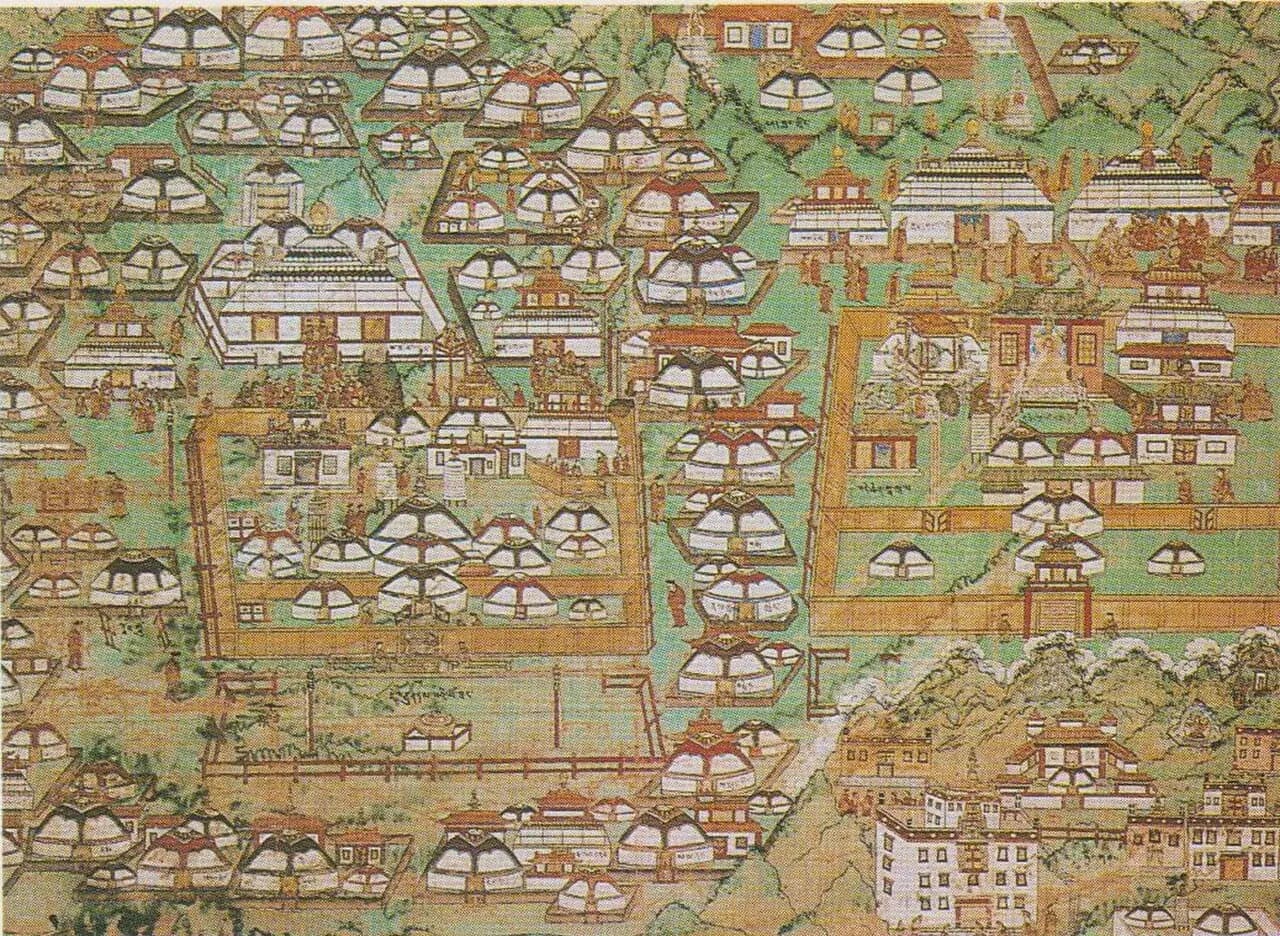
Photo: unknown Mongolian artist · Public domain · Wikimedia Commons
Mongolian folk art is a visual language of ornaments, colours and symbols that appears on everything from ger doors and deels to saddles, silver bowls and paintings. Its best-known motif is the ölzii, an endless knot standing for happiness and long life, but many other patterns carry their own meanings. Knowing a few of them makes museums, monasteries and even a family ger far more interesting to look at.
Traditional ornaments and khee patterns
Ornament is called khee or ugalz in Mongolian, and the same patterns are quilted into felt, painted on wood, embroidered on boots and engraved on silver. Some of the most common:
- Ölzii – the endless knot, a sign of good fortune, harmony and continuity. It is one of the Eight Auspicious Symbols of Buddhism and is also used widely in everyday design.
- Khan's bracelet (khaan buguivch) – interlocking rings standing for strength and unity.
- Hammer pattern (alkhan khee) – a continuous square meander that borders felt, furniture and ger doors, often read as a sign of firmness and endlessness.
- Horn pattern (ever khee) – spirals based on the horns of sheep, cattle or ibex, linked with herds and prosperity.
- Cloud pattern (üülen khee) – flowing curves associated with the sky and blessings.
- Soyombo – the national symbol combining fire, sun, moon and other elements, also shown on the national flag.
Colours and their symbolism
Colours carry widely shared associations, though meanings shift with context. Blue represents the Eternal Blue Sky and loyalty, and it is the usual colour of the khadag, the silk scarf offered as a sign of respect. White stands for purity, milk and good intentions, which is why dairy products are called white food and the Lunar New Year is Tsagaan Sar, the White Month. Red suggests fire, the sun, warmth and vitality. Yellow is linked with Buddhism and gold, and green with grassland and growth. Black is generally avoided in festive decoration.
Mongol zurag: the traditional painting style
Mongol zurag is a painting style rooted in Buddhist thangka painting and folk art. Artists use mineral and natural pigments with fine brushes on cotton or canvas, flat areas of colour without Western perspective, and crowded narrative scenes full of detail. The most famous classic example is One Day in Mongolia by the painter B. Sharav, created in the early 20th century. Across a single landscape it shows hundreds of small scenes of everyday life, from herding and felt making to weddings, archery and festivals. The painting is held at the Zanabazar Museum of Fine Arts in Ulaanbaatar. Since 1990 Mongol zurag has enjoyed a strong revival, and many contemporary artists now use the technique for modern subjects.
Where to see folk art today
Look for ornaments on ger doors and furniture, painted roof poles and crown rings, deel collars and cuffs, boots, snuff bottles and the tableware brought out at Tsagaan Sar. In Ulaanbaatar, Gandan Monastery and the Choijin Lama Temple Museum show painted and sculptural religious art, the National Museum of Mongolia covers costume and daily life, and private galleries sell contemporary Mongol zurag and prints.
Practical tips for travellers
- Start with the Zanabazar Museum of Fine Arts and the National Museum of Mongolia; confirm opening hours and ticket details on their official channels before going.
- When buying a painting, ask whether it is an original and who the artist is, and keep the receipt.
- Inside a ger, do not lean on the painted columns or step on the threshold; decorated parts of the home are treated with respect.
- Photography rules differ between museums and monasteries, so ask before taking pictures.
- Patterned items such as felt rugs, embroidered pouches and painted boxes make good souvenirs that carry real symbolism.
Frequently asked questions
What does the ölzii symbol mean?
The ölzii is an endless knot symbolising good fortune, harmony and continuity. It is one of the Eight Auspicious Symbols of Buddhism and is widely used in Mongolian design.
What is Mongol zurag?
Mongol zurag is a traditional painting style using natural pigments, flat colour and detailed narrative scenes, developed from Buddhist thangka painting and folk art.
Where can I see the painting One Day in Mongolia?
It is held at the Zanabazar Museum of Fine Arts in Ulaanbaatar. Check the museum's current opening hours before visiting.