Mongolian Bonecraft
Mongolian bonecraft guide: how to play shagai ankle-bone games, the UNESCO-listed sport of shagai shooting, and traditional bone carving and chess sets.
3 min read · Updated
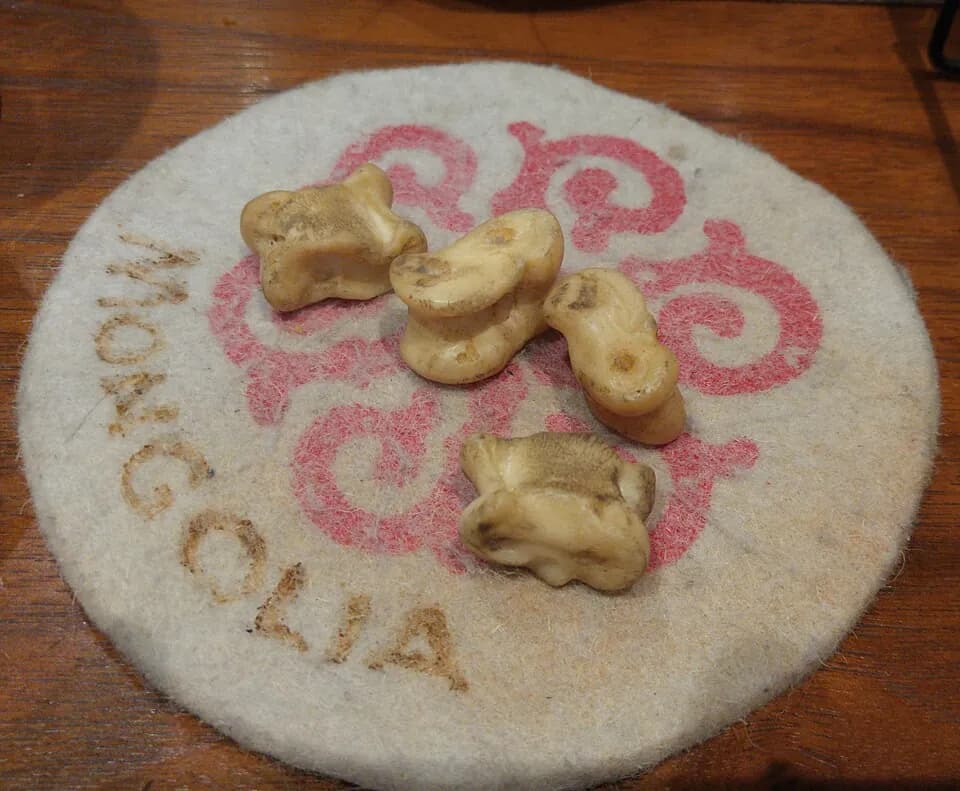
Photo: Asienreisender · CC BY-SA 4.0 · Wikimedia Commons
Mongolian bonecraft covers two linked traditions: games played with shagai, the ankle bones of sheep and goats, and the carving of bone into tools, ornaments and figures. Shagai games are still part of family life, especially during Tsagaan Sar, and Mongolian knuckle-bone shooting was inscribed on UNESCO's Representative List of the Intangible Cultural Heritage of Humanity in 2014.
What shagai are
A shagai is the astragalus, or ankle bone, of a sheep or goat. Each bone has four distinct sides that can land face up, and each side is named after one of the herd animals: horse, camel, sheep and goat. Families keep the bones from animals they have eaten, and a cloth bag of shagai is found in many gers and city apartments. Some bones are dyed red or polished smooth from years of handling, and children grow up playing with them.
Popular shagai games
There are dozens of shagai games, played mostly in winter and during Tsagaan Sar, the Lunar New Year:
- Horse race (mori uraldaan) – players line up shagai as a racetrack, throw four bones and move their horse forward for every horse side that comes up.
- Fortune telling – four bones are thrown and the combination of sides is read as a prediction; four different sides is considered very lucky.
- Flicking games – bones are scattered on the floor and players flick one shagai into another showing the same side, collecting each one they hit.
- Catching games – bones are tossed into the air and caught on the back of the hand.
These games teach counting, dexterity and patience and are often played by grandparents and grandchildren together.
Shagai shooting: a UNESCO-listed sport
Knuckle-bone shooting (shagai kharvaa) is a team game, usually with six to eight players per team. Each shooter flicks small, flat tablets, traditionally made from antler, horn or marble, along a smooth wooden board towards a target made of shagai a few metres away, aiming to knock the bones out of place. Teammates encourage each shooter with special melodies and calls, and experienced players are known for both accuracy and singing. Shagai shooting clubs compete in tournaments in Ulaanbaatar and the provinces, and competitions are commonly held as part of Naadam celebrations; check the current programme for times and venues.
Bone carving
Bone, horn and antler have long been carved into practical and decorative objects: knife handles, combs, buttons, pendants, small animal figures and dice. Mongolian chess (shatar) sets are a classic carved item, with pieces shaped as a noble, a lion or dog, camels, horses, carts and boys instead of the bishops, rooks and pawns of Western chess. Modern carvers mostly use cattle and camel bone, and fine sets are sold in Ulaanbaatar's craft and souvenir shops.
Practical tips for travellers
- Ask your host family to teach you a shagai game; it is an easy way to connect even without a shared language.
- A small set of shagai is an inexpensive souvenir, while a carved chess set is a more substantial gift.
- Avoid items that may be made from protected wildlife, such as argali or ibex horn. Exporting wildlife products can be illegal; check the rules with Mongolian customs and your home country before buying.
- If you are in Mongolia during Tsagaan Sar or Naadam, ask locally about shagai shooting competitions, which welcome spectators.
- Bone and horn items may be inspected at borders, so keep receipts showing what they are made of.
Frequently asked questions
What are the four sides of a shagai called?
The four sides are named after herd animals: horse, camel, sheep and goat.
When was shagai shooting listed by UNESCO?
Mongolian knuckle-bone shooting was inscribed on UNESCO's Representative List of the Intangible Cultural Heritage of Humanity in 2014.
Where can I watch shagai shooting?
Tournaments are held in Ulaanbaatar and the provinces, including around Naadam and Tsagaan Sar. Ask locally or check the current Naadam programme for dates and venues.