Nomadic Life in Mongolia
Nomadic life in Mongolia: seasonal moves between camps, the five animals, the herder's year, dzud winters and tips for staying with a herding family.
3 min read · Updated
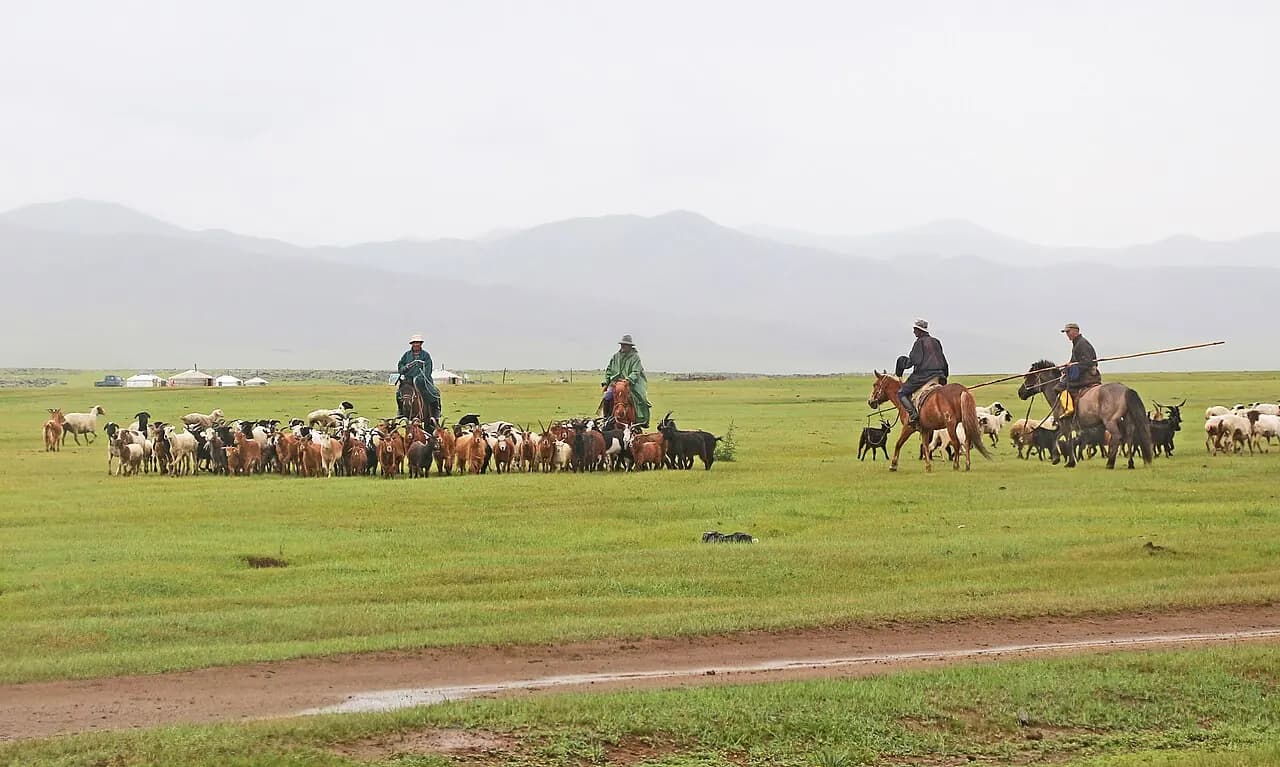
Photo: Bernard Gagnon · CC0 · Wikimedia Commons
Nomadic life in Mongolia means herding families moving their gers and livestock between seasonal pastures, usually two to four times a year, to give grass time to recover and to find shelter in winter. Their herds are made up of the "five animals" — horses, camels, cattle (including yaks), sheep and goats. Although many Mongolians now live in towns, herding remains a major part of the economy and of national identity.
Seasonal moves between camps
A herding family typically uses separate camps for different seasons: a winter camp (övöljöö) in a sheltered valley or on a south-facing slope, often with a wooden or stone animal shed; a spring camp (khavarjaa) where animals give birth; a summer camp (zuslan) near water and fresh grass; and an autumn camp (namarjaa) where animals fatten before winter. Distances vary enormously, from a few kilometres in the fertile north to much longer moves in the Gobi and the west. A ger can be taken down in about an hour and loaded onto a truck or, in remote areas, onto camels or carts. Pasture rights are based on long-standing custom and local agreements as much as on formal rules.
The five animals
- Horses: for riding, herding and racing, and for mare's milk, which is fermented into airag in summer.
- Camels: two-humped Bactrian camels, mainly in the Gobi, for transport, wool and milk.
- Cattle and yaks: cows on the lower steppe, yaks and hybrids in the mountains, valued for milk, butter and meat.
- Sheep: the backbone of most herds, providing meat, wool for felt and milk.
- Goats: source of the cashmere that is one of Mongolia's key exports.
Mongolia's national herd numbers in the tens of millions, many times the human population, although totals fall sharply after harsh winters.
The herder's year
- Spring: the hardest season, when animals are thin after winter. Lambs, kids and calves are born, and in April and May goats are combed for cashmere.
- Summer: the season of plenty. Families milk their animals several times a day and make dairy products such as aaruul (dried curds), urum (clotted cream) and airag, and local naadams bring communities together.
- Autumn: animals fatten on late grass, hay is cut where possible, and families prepare winter fuel and shelters.
- Winter: when temperatures stay below freezing, families slaughter animals for winter meat, which keeps naturally in the cold. They then sit out the long, cold months in the winter camp.
Dzud and a changing way of life
A dzud is a severe winter disaster in which deep snow, ice or extreme cold, often after a dry summer, prevent animals from grazing. Major dzuds, including those of 2009–10 and 2023–24, killed millions of livestock and pushed many families to move to towns. Today herders use solar panels, satellite TV, mobile phones and motorbikes, and children usually attend boarding schools in district centres during term time.
Tips for staying with a nomadic family
- Arrange homestays through a reputable tour operator, who can make sure the family is fairly paid.
- Bring a small useful gift, such as quality tea, fruit, school supplies or photos printed from a previous visit.
- Offer to help with chores like collecting water or dung fuel, but follow your hosts' lead around animals.
- Ask before photographing people, and follow ger etiquette: move clockwise and respect the hearth.
Frequently asked questions
How often do Mongolian nomads move?
Most herding families move two to four times a year between seasonal camps. Distance and frequency depend on the region, pasture and weather.
What are the five animals?
Horses, camels, cattle (including yaks), sheep and goats.
What is a dzud?
A dzud is a severe winter disaster in which deep snow, ice or extreme cold stop animals from grazing, causing large livestock losses.