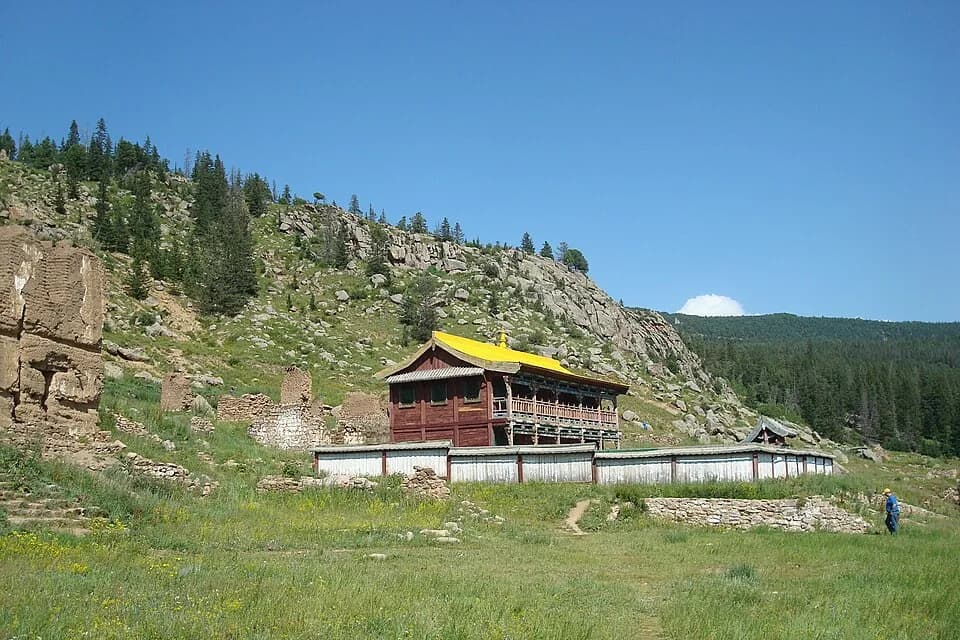
Ruins of an 18th-century monastery in the forest on the south side of Bogd Khan Uul, near Zuunmod.
Manzushir Monastery stands in a wooded valley on the southern slope of Bogd Khan Uul, about 6 km north-east of Zuunmod, inside the Bogd Khan Uul Strictly Protected Area. Founded in 1733 and destroyed in 1937, it is now a quiet site of temple foundations, a rebuilt main temple that serves as a museum, a large bronze cauldron and Buddhist paintings on the rocks above.
The mountain
Bogd Khan Uul rises to about 2,260 m at Tsetseegun and has been protected for centuries. Its core covers about 41,650 ha, and since 1996 it has been part of a UNESCO biosphere reserve. The mountain sits at the southern edge of the forest steppe. Its northern side is covered in dense conifer forest, while the southern side, where the monastery is, is drier and more open, with rocky slopes and woodland in sheltered valleys. The forests mix Siberian larch, birch, Siberian pine (locally called cedar) and other pines. Musk deer, roe deer, red deer and sable live here, but they are shy and hard to see.
Walks and seasons
Allow two to three hours for the museum, the ruins and the rock paintings, or a full day if you walk up towards Tsetseegun, from where you can see down to Ulaanbaatar on the other side of the mountain. The site can be visited all year. June to August brings green meadows and wildflowers. September has autumn colour and settled weather, and in winter the snowy forest is very quiet, but paths are icy and the cold is severe.
Visiting respectfully
Bogd Khan Uul is a sacred mountain as well as a protected area. Stay on the paths, do not light fires, pick plants or disturb wildlife, and take all rubbish with you. Walk clockwise around the temple and any ovoo, and do not climb on the ruins or touch the rock paintings.
Photo: Arabsalam · CC BY-SA 4.0 · Wikimedia Commons
History
The history of Manzushir Monastery
Founding
The monastery was founded in 1733 by the monk Luvsanjambaldanzan as the seat of the reincarnation of Manjushri, the bodhisattva of wisdom. In 1750 it came under the direct administration of the Jebtsundamba Khutuktu, the head of Buddhism in Mongolia. It grew to about 20 temples and more than 300 monks. The Togchin temple, whose ruins remain, was built in 1749, and the bronze cauldron that survives on the site, cast in 1726 and weighing about two tonnes, could boil ten sheep and two cattle at once.
Destruction
The monastery was caught up in the Stalinist repressions of the late 1930s. In 1937 its remaining monks were arrested and many were later shot; its abbot, Sambadondogiin Tserendorj, who had briefly served as acting prime minister in 1921, was executed in Ulaanbaatar after a show trial that October. All the temples were destroyed, and the scriptures were taken to the National Library.
Restoration
Restoration of individual buildings began in 1990, and in 1998 the ruins were placed under state protection. Only the main temple has been rebuilt; it now serves as a museum. Paintings and reliefs carved on the rocks above the monastery in the 18th century, with Tibetan inscriptions, survived the destruction. Bogd Khan Uul itself has been protected since the 18th century, which makes it one of the oldest protected areas in the world.
Things to do at Manzushir Monastery
4 activities · best season: Spring, Summer, Autumn, Winter
Museum · 1 h
Visit the temple museum
The rebuilt main temple displays old photographs and objects from the monastery, as well as exhibits on the local plants and animals.
History · 1 h
Walk among the ruins
Trace the foundations of the old temples, see the ruins of the Togchin temple and the large bronze cauldron cast in 1726.
Culture · 1 h
See the rock paintings
A short climb behind the monastery leads to 18th-century Buddhist images painted and carved on the rocks, with views over the valley.
Hiking · 5–6 h
Hike to Tsetseegun summit
A trail through larch forest climbs to Tsetseegun, the highest point of Bogd Khan Uul at about 2,260 m. Paths can be muddy, rocky and blocked by fallen trees; take a map or a guide.
Read the guide →
When to go & how to get there
Weather by month
Getting there
Zuunmod, the centre of Töv aimag, is about 43 km south of Ulaanbaatar on a paved road, around an hour by car. Buses run from Ulaanbaatar to Zuunmod, and from there the monastery is about 6 km by taxi or a walk of around two hours. Most visitors come on a day trip by car.
Where to stay
A tourist ger camp operates near the monastery, and Zuunmod has basic services. Most people visit as a day trip from Ulaanbaatar; camping is restricted in the protected area, so check the rules at the entrance.
Gallery
4 photos · tap to enlarge · sources credited on each photo
Where is Manzushir Monastery?
from Ulaanbaatar from Zuunmod · a dotted end marks a stretch with no road
Töv province · nearest town: Zuunmod
Guides that mention Manzushir Monastery
Central
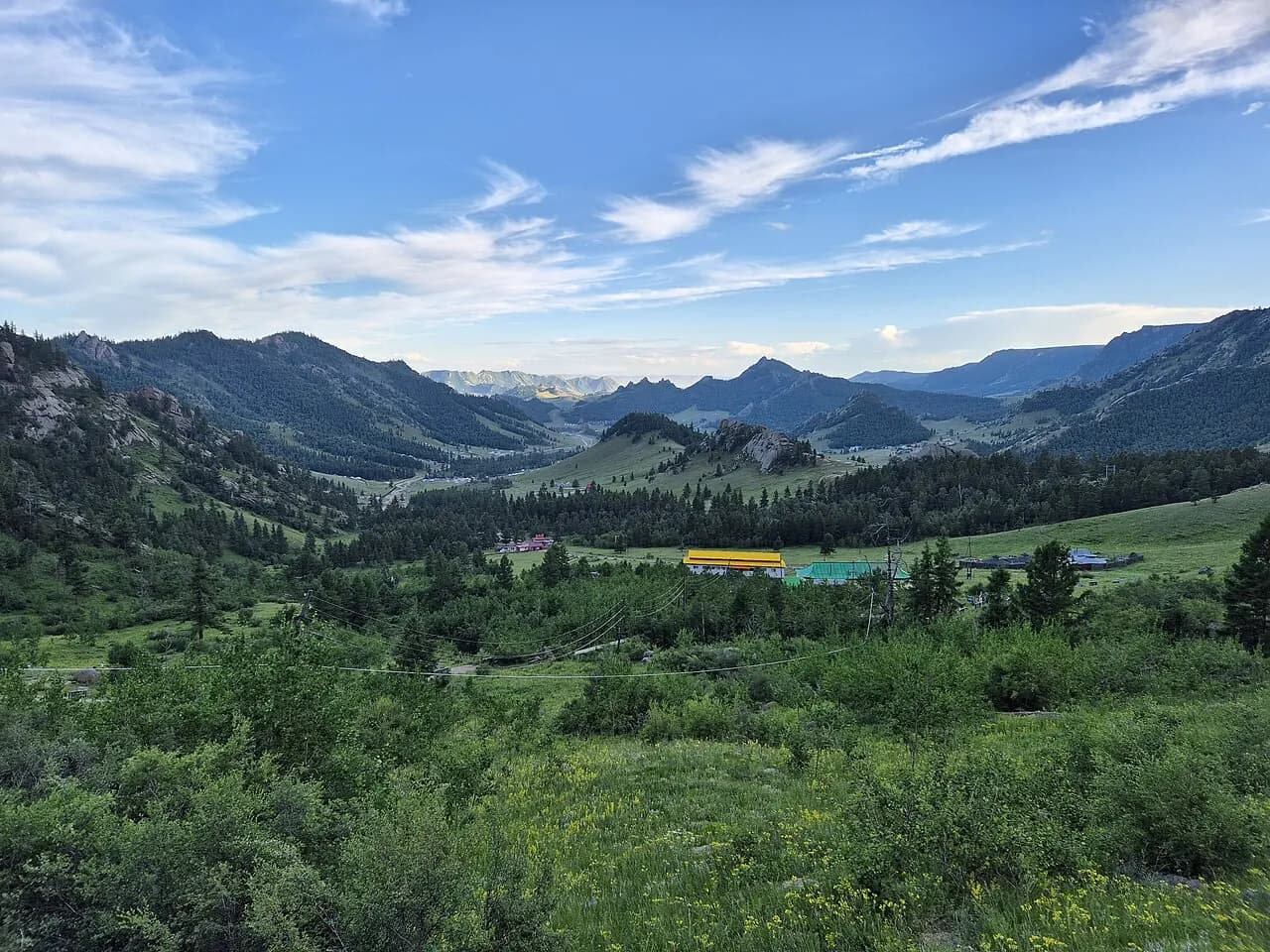
Gorkhi-Terelj
Rocks, forests and ger camps 1.5 hours from the capital.
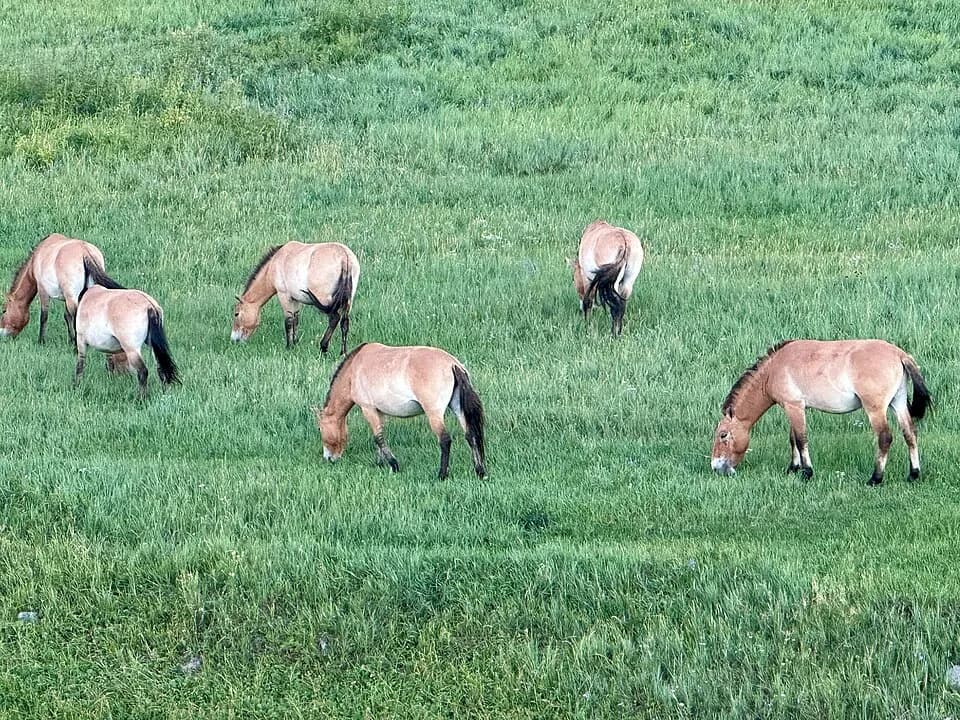
Khustai National Park
Steppe and birch-covered hills west of Ulaanbaatar where wild takhi horses were returned to Mongolia.
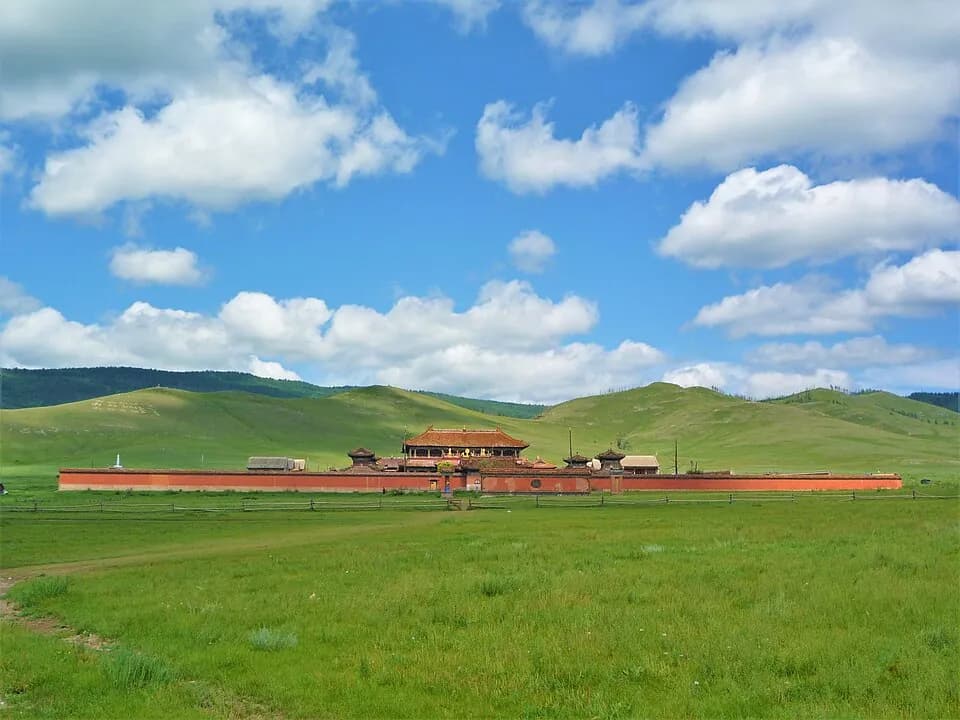
Amarbayasgalant Monastery
An 18th-century Qing-era monastery built for Zanabazar in the remote Iven valley of Selenge.