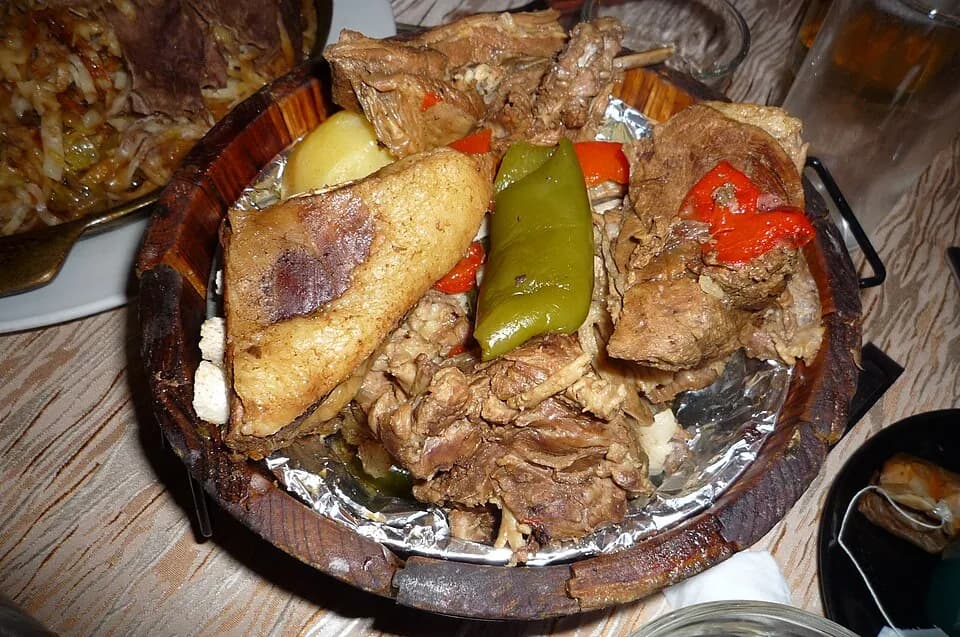
Photo: Brücke-Osteuropa · Public domain · Wikimedia Commons
Ceremonial dishes
Khorkhog
Mutton cooked with red-hot stones in a sealed pot, the summer camp feast.
What it is
Khorkhog is mutton cooked with stones that have been heated in a fire. Fist-sized stones go into a closed container together with bone-in meat, a little water and usually potato, carrot and onion. The heat stored in the rock turns the water to steam and sears the meat where it touches, so everything cooks from the inside of the pot outwards. The result is tender meat on the bone, vegetables soaked in mutton fat and a small amount of rich broth.
The dish is a close relative of boodog, in which hot stones are placed inside the skin of a whole goat or marmot. Khorkhog moves the same idea into a vessel, and today that vessel is usually a metal milk can or another sturdy lidded pot. Mutton is standard, though goat is sometimes used instead.
How it is made
Most of the effort goes into the fire. A cook heats around 10 to 20 smooth stones until they are very hot, then layers them with the meat so that as many pieces as possible are in contact with rock. The lid is closed and, if the stones start to lose heat, the pot can be set back on the fire or stove. Experienced cooks judge progress by the sound of the pot and the smell of the steam rather than by a clock; the meat usually needs up to about an hour and a half.
When the pot is opened the stones have turned black from the heat and from the fat they have absorbed. Smooth, dry stones are preferred, because wet or cracked rock can split in a hot fire.
When and where to try it
Khorkhog is outdoor food for a group rather than an everyday meal. Herding families make it when guests arrive, for family gatherings and for picnics in the warmer months, when animals are in good condition after summer grazing. Many ger camps and homestays can prepare it if you ask a day or so ahead, since it uses a whole lot of meat and a long fire. Some restaurants in Ulaanbaatar serve versions of it, but the countryside, where it is cooked over wood or dung fires, is where most travellers taste it.
Etiquette and tips
- When the pot is opened, the hot stones are usually handed out first. People toss them from hand to hand while they are still warm and greasy, a practice believed to be good for the body.
- Let a stone cool for a moment before you take it; they can stay hot enough to burn.
- Khorkhog is eaten with the fingers, with a knife to cut meat from the bone. Expect fat to be part of the dish, and choose a leaner piece if you prefer.
- Accept the portion the host offers with your right hand or both hands, and taste at least a little even if you do not eat much mutton.
- Ingredients
- Bone-in mutton, river stones, potato, carrot, onion, salt
- How it is made
- Heat stones for an hour, alternate meat and stones in the pot, seal and steam for 60 to 90 minutes.
- Health & season
- A summer and autumn dish; one large pot feeds a family or a group of guests. · Summer, Autumn
- Famous in
- Khangai & Central, Central, Western Mongolia
Photo: Brücke-Osteuropa · Public domain · Wikimedia Commons
Where to eat real Mongolian food in Ulaanbaatar